
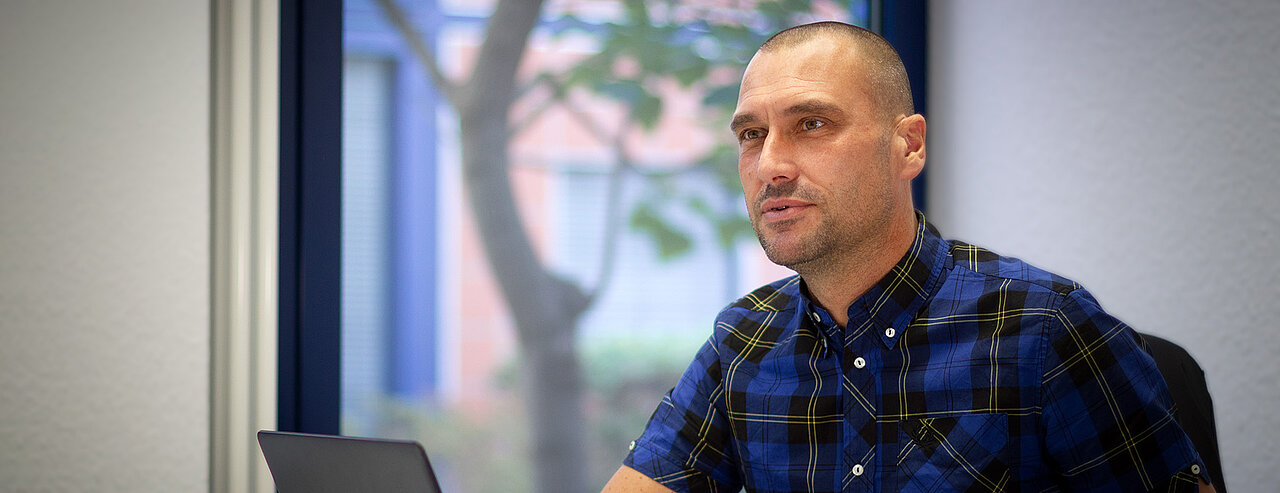
Prof. Dr. Phil C. Langer
Psychoanalytic Social Psychology and Social Psychiatry
IPU Berlin
Alt-Moabit 91A, 2nd Floor, Room 2.04
10555 Berlin
E-Mail: phil.langer@ipu-berlin.de
Teaching Focus
At the centre of my teaching is the reflective mediation of the paradigmatic way of thinking and research of a critical social psychology and a social psychologically informed view of the discourses and professional practices of social psychiatry. As part of the social sciences, social psychology and social psychiatry derive their particular strength from their view of the social localisation and interconnectedness of subjects, their experiences and actions, their diverse social disciplining and experiences of suffering, but also their social agency and the opportunities for their emancipation. Understood in this way, it is about the development of a systematic inter- and transdisciplinary perspective on the always conflictual relationship between subject and society as a subject-related contribution to understanding the necessity and conditions for success as well as the critical-reflexive accompaniment of social and political change.
At the IPU, I am involved in teaching on several degree programmes, including:
- In the Bachelor's degree programme in Psychology, I teach social and health psychology basics and qualitative methods of empirical research (modules 1A, 6B, 15).
- In the Master's degree course in Psychology with a Clinical Focus, I have given seminars on social psychology and the theories and programmes of prevention and health promotion (modules 2 and 9) in recent semesters, particularly for the part-time groups.
- Every winter semester, I offer the seminar ‘Social Psychological Perspectives on Society’ in the compulsory elective subject ‘Social and Cultural Science Perspectives’ (MOdul 10c) with different thematic focuses.
- On the English-language Master's in Psychology focussing on Organisation course, which has been running since winter semester 2023/24, I teach qualitative methods (modules 7 and 8), environmental psychology (module 4) and work, health and prevention (module 5).
- In the Master's programme in Interdisciplinary Psychosis Therapy, I am involved in topics such as social psychiatry and health sciences, which deal with the significance of biographical, social and cultural factors for mental health, and participatory approaches (modules K2, K3 and K4).
- In the Master's degree course in Leadership and Counselling, I am keen to teach qualitative methods of empirical organisational research and diagnostics and to develop their potential applications for Master's theses together with the students.
Through interactive formats, the invitation of guest speakers, excursions beyond the university framework and reference to my own research, I try to keep the teaching lively and contribute to what Klaus Heinrich (1987) once defined - as a necessity in light of a sharp diagnosis of its increasing weakening - as the eroticisation of the relationship between students and the institution of the university.

Research Focus
In recent years, I have mainly been involved in research into the psychosocial dynamics of collective violence. Among other things, this has involved externally funded research projects that have focussed on experiences of violence in conflict and war zones in an empirically qualitative manner:
- In the Afghan Youth Project, we analysed the consequences of everyday violence for the identity formation and social agency of young people in Afghanistan. Publications on the project include the books Jugend in Afghanistan and Afghan Women in Solidarity. Counter Narratives on the Dialectics of Oppression and Token Recognition, the research report Glimpses of Hope in the Shadow of War and the article ‘Educational Transitions in War and Refugee Contexts: Youth Biographies in Afghanistan and Austria’
- In project What Helps the Helpers?, funded in the context of the regional project ‘Psychosocial Care for Syrian and Iraqi Refugees and Internally Displaced Persons’ of the GIZ, we developed, implemented and evaluated a concept of organisational staff care in selected organisations in the Middle East (REST = Responding to Staff Care Needs in Fragile Contexts). The Introductory Guide, the Assessment Tool and the Facilitation Manual are freely available online.
- In an ongoing project, we are investigating the psychosocial needs of former child soldiers of the Islamic State in northern Iraq and have developed a participatory method of trauma-sensitive psychosocial work with vulnerable groups using collaborative storytelling. This resulted in the articles ‘Keine Keine Zukunft. Nirgends' and “Translating Trauma into Testimony: Collaborative Storytelling with Former ISIS Child Soldiers in Northern Iraq”. The article ‘Motivational dynamics of German Salafist jihadists: A multi-methodical in-depth study of three paradigmatic cases’, which emerged from Mika Moeller's doctoral project, should also be seen in a broader context.
- A project that is aimed at reconstructing the experiences of flight and arrival based on qualitative biographical interviews with young refugees in Germanycurrently is currently being finalised (Vision 2022). We hope that the book on the project, entitled So sollte niemand leben müssen will be published in 2024.
Current research projects:
- Psychosocial Needs of Former ISIS Child Soldiers in North Iraq (funded by the GIZ and as part of start-up funding from the IPU)
- Vision 2022: Biographical Trajectories of Flight and Future Perspectives of Young Refugees in Germany (funded by the Foundation for Analytical Psychiatry)
- So close to heaven: Discourse-analytical study on discrimination against women in ski flying and in the Catholic Church (in cooperation with Prof Claudius Wagemann, Goethe University Frankfurt)
- ‘Come on a trip with us and we'll show you another world!’ Camp worlds as spaces of right-wing extremist communitisation (together with Sebastian Winter; funded by the Köhler Foundation)
Completed projects (selection):
- What Helps the Helpers? Resonding to Staff Care Needs in Fragile Contexts (2018-2020)
- The Afghan Youth Project: Wenn der Krieg im Kopf den Blick auf Frieden trübt. Eine empirische Untersuchung zu den Folgen traumatischer Erfahrungen kollektiver Gewalt für Identität, Gesellschaftsbilder und Agency von Jugendlichen in Afghanistan (2015-2019)
- Was hilft im Nahen Osten? Selbstverständnisse, Hilfetheorien und Organisational Care-Instrumente im Bereich MHPSS in der Region Syrien (2016-2018)
- 50 plus HIV. Älter werden mit HIV und Aids in Deutschland (2014-2015)
- ISAF 2010: Einsatzwirklichkeiten in Afghanistan aus Sicht der Soldatinnen und Soldaten der Bundeswehr (2009-2011)
- Spätdiagnose HIV. Psychosoziale Hintergründe und Ansätze für die Prävention (2010)
- Positives Begehren. Psychosoziale Dynamiken des sexuellen Risikoverhaltens homosexuell lebender Männer in Deutschland (2005-2007)
- Schulische Herausforderungen der Thematisierung von Nationalsozialismus und Holocaust (2005-2007)
Please note that I will be on a research sabbatical until the end of September 2026.
Information for students:
- Please use the team mailbox for emails: sozpsy@ipu-berlin.de. We will work together to ensure that we usually reply to you within three working days.
- There is one exception: please send Bachelor’s internship enquiries directly to praktikum.bachelor@ipu-berlin.de.
- Consultation hours during the summer semester take place between 12.00 and 14.00 on: 15 April, 29 April, 6 May, 20 May, 27 May, 3 June, 10 June, 17 June. To book a consultation appointment, please use the following link: [Book a consultation]
- If you would like to write your final thesis with me in or after the winter semester of 2025/26, please read the guidelines for developing and writing Bachelor or Master's theses, which supervise, and in light of these, check whether your project idea is in good hands with me. All spots are currently filled; I will be able to accept new students again in the 2025–26 winter semester. If you are interested, please come see me during office hours starting in October 2026.